
When topical formulations stall, clinical-grade LED light therapy offers a biological workaround to restore cellular function.
A Deep Dive into Tachyphylaxis and Mitochondrial Reset
Why Your Skincare Has Simply Stopped Working
Have you ever felt that your skincare has simply stopped working? You invest in multiple gold-standard serums, you adhere to ten-step rituals, yet the results often plateau. You might be experiencing a form of tachyphylaxis—a phenomenon where the skin’s biology adapts or becomes tolerant to active ingredients. While traditionally a pharmaceutical term, tachyphylaxis is a critical factor to consider in dermocosmetics when topical efficacy stalls.
The secret to breaking this plateau lies in photobiomodulation—using LED light therapy to boost product absorption by targeting the heart of the cell: the mitochondria.
The Bioenergetics of Aging: ATP and the Mitochondria
Think of your skin cells as high-performance engines. To process active ingredients, they require a specific biological currency: Adenosine Triphosphate (ATP). Mitochondria, the “powerhouses” of the cell, produce this ATP, which is essential for DNA repair, collagen synthesis, and antioxidant defense.
As we age, mitochondrial function declines, leading to cellular senescence—a state where the cell can no longer keep pace with environmental damage. This is compounded by the skin exposome, the total biological and environmental assault on our skin over time. If your mitochondria aren’t optimized, even the most sophisticated serums will fail to deliver results.
How LED Light Therapy Works: The CCO Pathway
Photobiomodulation is a non-thermal, photochemical process. Light energy is absorbed by chromophores in the skin, specifically a photoreceptor called Cytochrome C Oxidase (CCO) located within the mitochondrial respiratory chain.
In aging or stressed skin, nitric oxide binds to CCO, blocking the electron transport chain and decreasing ATP production. LED light therapy facilitates a photorejuvenation process by displacing that nitric oxide, allowing for an influx of oxygen, accelerating the transport chain, and boosting ATP synthesis.
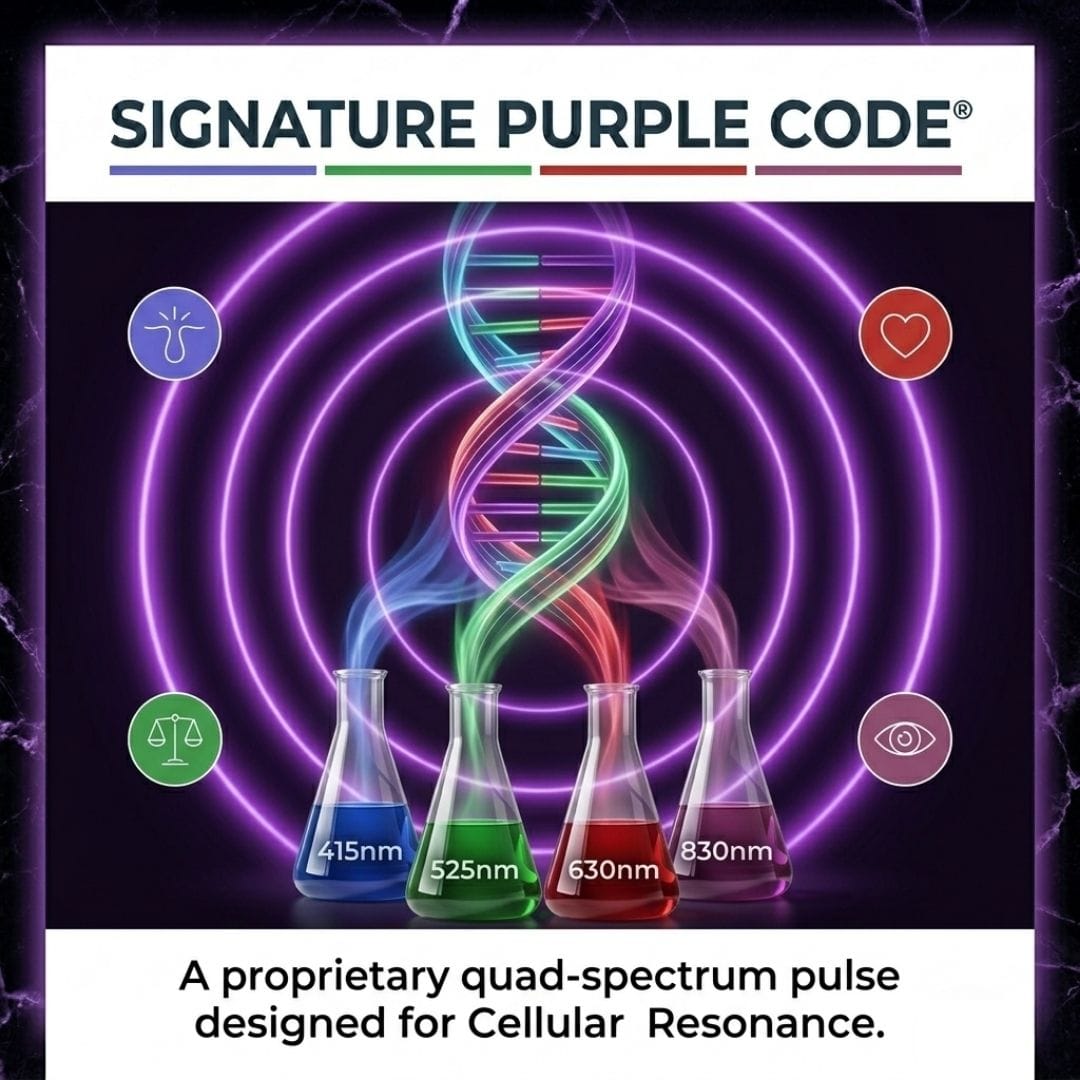
The Signature Purple Protocol: Quad-Spectrum Synergy
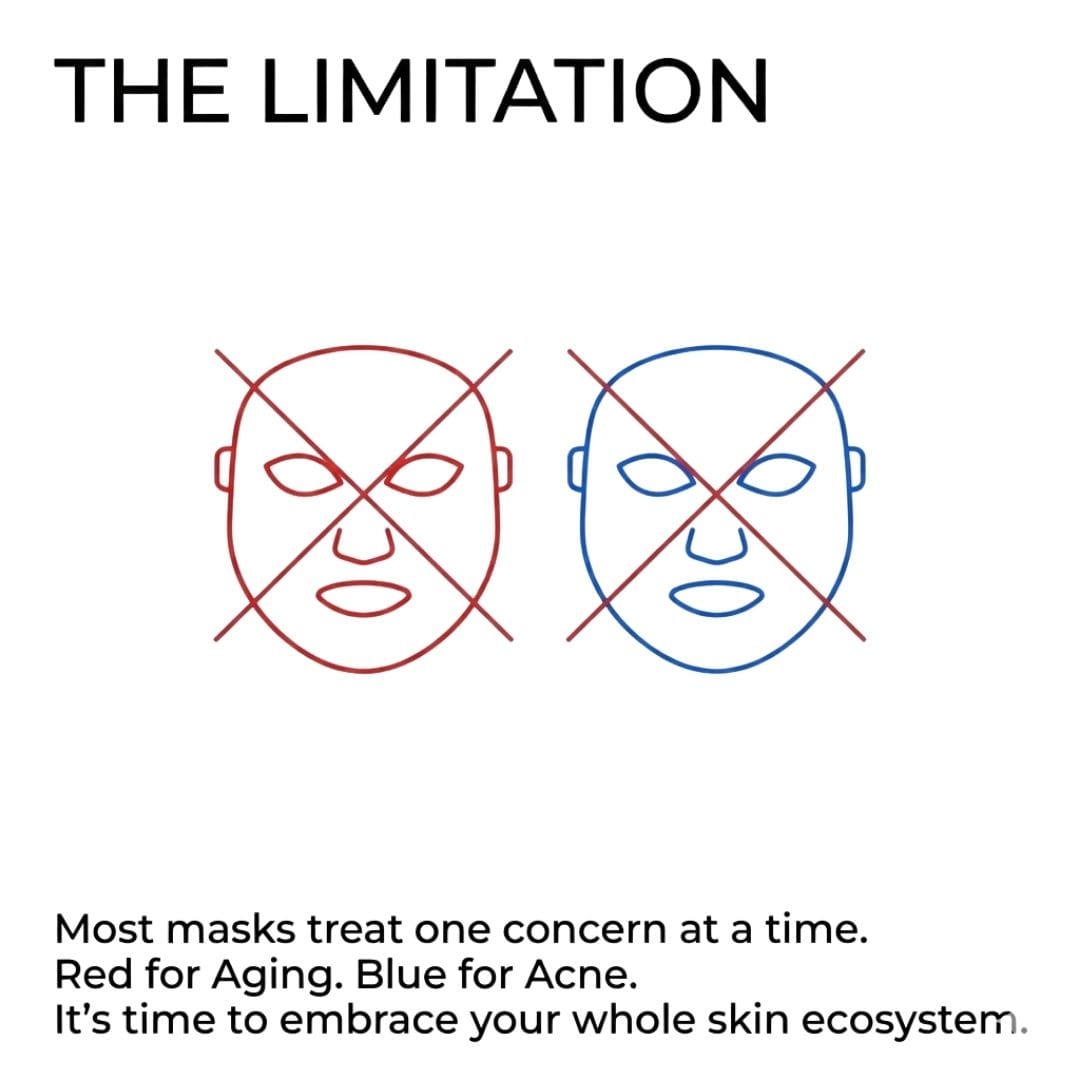
While the market has long focused on individual wavelengths—red for collagen or blue for acne—advances in photobiomodulation and multi-spectrum LED light therapy now allow for simultaneous wavelength delivery. In a clinical study of 30 patients in a tropical Southeast Asian setting, this Signature Purple Code® Protocol combined with ethnobotanicals showed significant improvements in the skin microclimate.
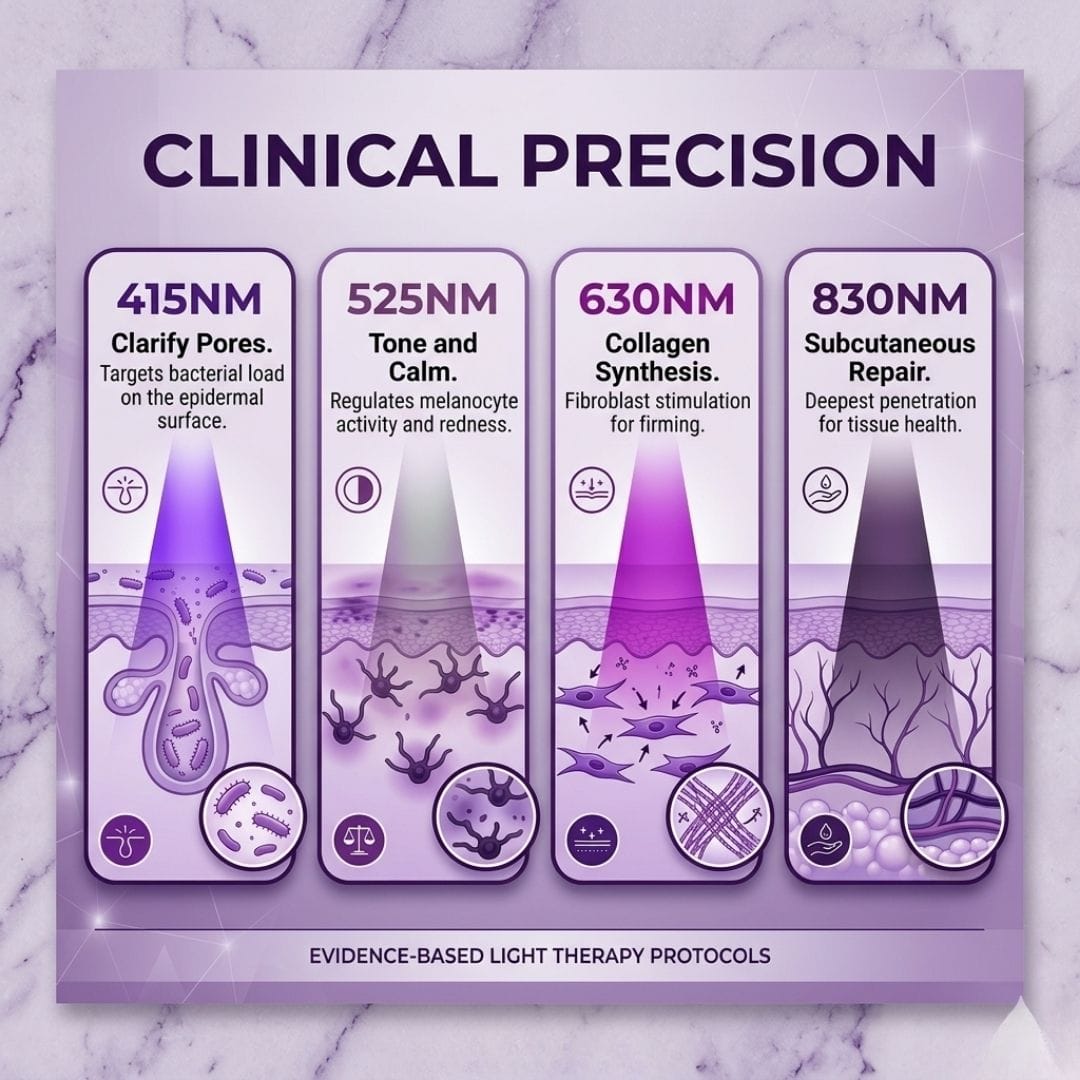
Technical Wavelength Breakdown:
- 415 nm (Blue Light): Targets porphyrins within C. acnes bacteria (that cause acne). It triggers a singlet oxygen reaction that destroys bacterial cell walls from within.
- 525 nm (Green Light): Often neglected, this wavelength targets melanocytes at the dermal-epidermal junction. It regulates pigment activity and stabilizes the skin’s response to UV and inflammation, crucial for conditions like melasma.
- 630 nm (Red Light): The “collagen stimulator.” It penetrates the papillary dermis to upregulate Type 1 and 3 procollagen while blocking the enzymes (MMPs) that digest existing collagen.
- 830 nm (Near-Infrared): Invisible but powerful, it reaches the subcutaneous layers and lymphatic system. It shifts macrophages from an inflammatory to a healing state, resetting the skin’s structural integrity.
Dosimetry Matters: Medical-Grade vs. Beauty-Grade
The reason many standard beauty gadgets fail is poor dosimetry. A device may appear bright, but its irradiance—the actual density of photons reaching the cells—is often deficient.
The Aurora device uses a proprietary quad-spectrum engine designed to deliver a consistent irradiance of 10 to 30 milliwatts per square centimeter (10-30 mW/cm^2). This matches FDA-approved medical standards, ensuring a sufficient photon dosage to clear the CCO pathway and induce total cellular resonance. This is not just surface brightening; it is a deep mitochondrial repair protocol.
Clinical Comparison
| Clinical Benchmark | Signature Purple Code® (Aurora) | Standard Consumer LED Mask |
| Spectral Profile | Quad-Spectrum (4-Chip Engine) | Dual-Spectrum (2-Chip) |
| Hard Science Wavelengths | 415, 525, 630, 830nm | 630 & 415nm Only |
| Mechanism | Total Cellular Resonance | Fragmented Surface Therapy |
| Dosimetry | 10–30mW/cm² (Clinical Grade) | <5mW/cm² (Beauty Grade) |
| Outcome | Mitochondrial Reset & Repair | Minor Surface Brightening |
As a dermatologist, my mission is to bring high-end clinical performance into your daily life. The Aurora Photon System is the intersection of minimalist luxury and the most advanced light physics available in dermatology today.
Experience the resonance. Bio-hack your longevity. Own the Iconic Glow.
Scientific References & Clinical Evidence:
- Barolet D, Roberge CJ, Auger FA, Boucher A, Germain L. Regulation of skin collagen metabolism in vitro using a pulsed 660 nm LED light source: clinical correlation with a single-blinded study. J Invest Dermatol. 2009 Dec;129(12):2751-9. doi: 10.1038/jid.2009.186. Epub 2009 Jul 9. PMID: 19587693.
- Heiskanen V, Hamblin MR. Photobiomodulation: lasers vs. light emitting diodes? Photochem Photobiol Sci. 2018 Aug 8;17(8):1003-1017. doi: 10.1039/c8pp90049c. Erratum in: Photochem Photobiol Sci. 2018 Oct 31;18(1):259-259. doi: 10.1039/c8pp90049c. PMID: 30044464; PMCID: PMC6091542.
- R Glen Calderhead, THE PHOTOBIOLOGICAL BASICS BEHIND LIGHT-EMITTING DIODE (LED) PHOTOTHERAPY, LASER THERAPY, 2007, Volume 16, Issue 2, Pages 97-108, .
- Mima Y, Yamada T, Omatsu J, Yamashita T, Suzuki S, Takechi T, Ichikawa M, Yamazaki K, Sato S, Yoshizaki A. Inhibitory Effect of 505 nm Green Light Emitting Diode on Melanin Synthesis in Cellular Experiments and a Human Intervention Study. Acta Derm Venereol. 2025 May 15;105:adv43441. doi: 10.2340/actadv.v105.43441. PMID: 40375536; PMCID: PMC12105538.
- Hamblin MR. Mechanisms and applications of the anti-inflammatory effects of photobiomodulation. AIMS Biophys. 2017;4(3):337-361. doi: 10.3934/biophy.2017.3.337. Epub 2017 May 19. PMID: 28748217; PMCID: PMC5523874.
- Huang YY, Chen AC, Carroll JD, Hamblin MR. Biphasic dose response in low level light therapy. Dose Response. 2009 Sep 1;7(4):358-83. doi: 10.2203/dose-response.09-027.Hamblin. PMID: 20011653; PMCID: PMC2790317.
- Papageorgiou P, Katsambas A, Chu A. Phototherapy with blue (415 nm) and red (660 nm) light in the treatment of acne vulgaris. Br J Dermatol. 2000 May;142(5):973-8. doi: 10.1046/j.1365-2133.2000.03481.x. PMID: 10809858.
The Aurora Photon System and Signature Purple Code® protocols are currently validated at the Asian Bio-Dermatology Research Institute and available with free international shipping www.drtwlderma.com.