
Is Skin Type Just a Biological Myth?
Here’s a dermatologist’s take. Categorizing your face as oily/dry or combination is scientifically obsolete. At the Asian Skin Research Institute’s Biodermatology Division, our quest has gone beyond skin types to the treatment of Zonal Dysbiosis. Join Dr. Teo Wan Lin, board-certified dermatologist, chief scientific officer and author of peer-reviewed papers on zonal dysbiosis in leading dermatology journals as she unveils her latest research.
Here’s what we cover in this episode:
- Your face as a topographic map and complex ecosystem with distinct zonal microclimates
- Our work at the institute fusing Eastern botanical adaptogens with modern peptides to target specific inflammatory pathways
- The role of fermentation in the 500 Dalton rule: molecular size determines absorption
Interview with Dr Teo Wan Lin, creator of the Bibang Protocol at the Asian Skin Research Institute

Founder’s Note
In both Korean and Chinese, the term Bibang (비방 | 秘方) carries a powerful weight: it translates literally to a “Secret Formula”—a hidden prescription passed down through lineages to preserve health and vitality.
In this season of the Lunar New Year—a season defined by the honoring of lineage and the promise of renewal—I find myself reflecting on the intersection of heritage wisdom and modern biotechnology. It is with this spirit of evolution that I am thrilled to unveil our new dedicated research division in China: The Asian Research Institute with a Bio-Dermatology division dedicated to overcoming the 500 Dalton principle with advanced biofermentation processes.
Our focus on the Fermentation Facelift ™—a proprietary protocol that utilizes advanced enzymatic hydrolysis to bio-engineer raw botanicals into micro-molecular weights. By reducing the molecular size of storied actives like Mugwort and Oryza Sativa, we are finally bridging the gap between the traditional idea of an ancient beauty secret and the modern concept of enhancing bioavailability for better dermal absorption.
In this new chapter, we prove that the secrets of the past and the precision of the future belong together. May this new year bring a season of renewed glow and deep-rooted vitality to your ritual.Welcome to the future of the Founders Formula, imbued with the heritage of TCM and refined by modern biotechnology. A New Era beckons in 2026, shaped by the Bibang Protocol ™.
You have an existing facility in Korea, why the expansion into China?
The backbone of our cosmeceutical formulations (manufactured in Korea since 2016) has always been the fusion of eastern ethnobotanicals with modern clinical peptides. The fact is that China is the world leader in pharmaceutical grade raw material production especially when it comes to rare ethnobotanical extracts we use in the Founder’s Formula. Our research focus on zonal dysbiosis and the skin microclimate directly links to the development of ethnobotanical-peptide dermocosmetic formulations for our skincare line.
The whole point setting up the Asian Research Institute in Guangdong was to get closer to the source—where we can truly be at the cutting edge of botanical biotechnology—it’s a highly developed medical biotech infrastructure we are leveraging on in this part of China, quite literally the global epicentre of pioneering cosmetic biotech. So making ourselves part of the ecosystem is the most efficient progression given that our Seoul/Busan facilities are at capacity and the existing Founder’s Formula range of dermocosmetics is mature.
From my brother Justin’s viewpoint—he’s the pharmaceutical engineering lead, it’s about access to the raw materials, better control over the Q/C processes and a more streamlined production line from research and development, rigorous clinical testing facilities to final product formulation and packaging—all on-site.
What drives your research at the Asian Skin Research Institute?
My work on the skin microclimate and microbiome is founded on my observation of zonal dysbiosis—the fact that skin is not a uniform canvas nor is it as simple as relegating an entire organ to a single “skin type” but that it is a living organism that represents a complex map of biodiversity.
Why did you create the Bibang Protocol TM?
I debunked the myth of skin type in my white papers on maskne and dysbiosis in my 2021 publications, and since then my research has been focused on the interaction of ethnobotanicals with the skin microclimate. At the Asian Bio-Dermatology Insitute, our work is driven by a passion to harmonise ancient wisdom with cutting edge biotech—the Bibang Protocol ™ represents more than my Eastern heritage, it’s a global quest for an answer to beauty. And it’s found within.
About the Asian Skin Research Institute
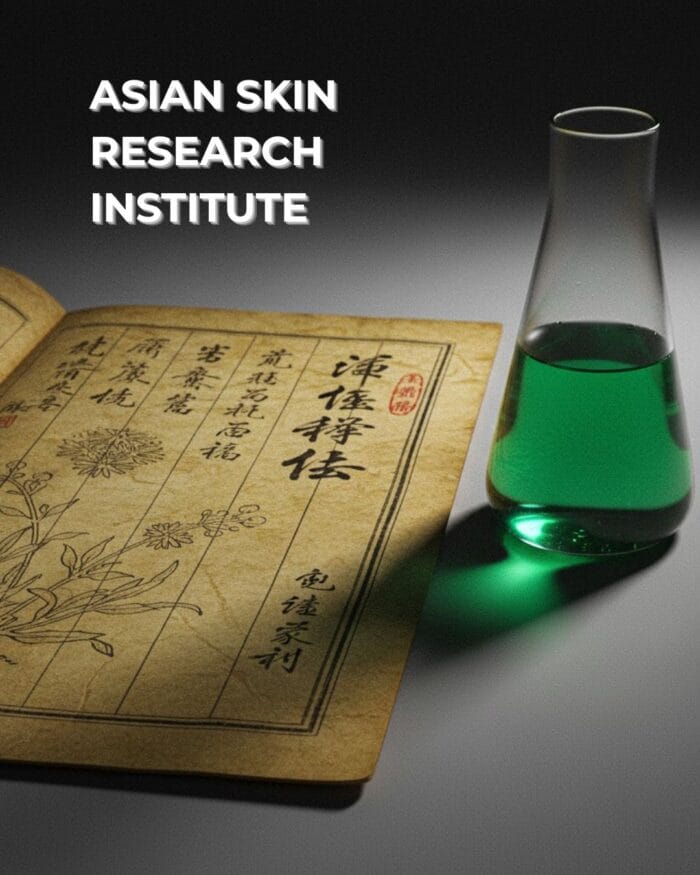
At the Asian Skin Research Institute’s Biodermatology Division, our quest has gone beyond skin types to the treatment of Zonal Dysbiosis. Join Dr. Teo Wan Lin, board-certified dermatologist, chief scientific officer and author of peer-reviewed papers on zonal dysbiosis in leading dermatology journals as she unveils her latest research. The Dr.TWL Asian Skin Research Institute is a dermatological research authority dedicated to the science of Asian Bio-Dermatology. Headquartered in Singapore with advanced research divisions in China, the Institute pioneers the use of biotechnology to decode traditional beauty wisdom.
Overcoming the 500 Dalton Rule with the Fermentation Facelift™
It is the home of the Fermentation Facelift ™ and the Bibang Formula ™, offering a prescriptive, evidence-based approach to skin health and longevity. Our focus on the Fermentation Facelift ™—a proprietary protocol that utilizes advanced enzymatic hydrolysis to bio-engineer raw botanicals into micro-molecular weights. By reducing the molecular size of storied actives like Mugwort and Oryza Sativa, we are finally bridging the gap between the traditional idea of an ancient beauty secret and the modern concept of enhancing bioavailability for better dermal absorption.
References
Teo WL. The “Maskne” microbiome – pathophysiology and therapeutics. Int J Dermatol. 2021 Jul;60(7):799-809. doi: 10.1111/ijd.15425. Epub 2021 Feb 12. PMID: 33576511; PMCID: PMC8013758.
Teo WL. Diagnostic and management considerations for “maskne” in the era of COVID-19. J Am Acad Dermatol. 2021 Feb;84(2):520-521. doi: 10.1016/j.jaad.2020.09.063. Epub 2020 Oct 1. PMID: 33011321; PMCID: PMC7528820.